
 Powered by Google
Description
The Temple of Augustus is a unique ancient monument in the heart of Ankara whose walls preserve the famous Res Gestae inscription of Emperor Augustus.
Story
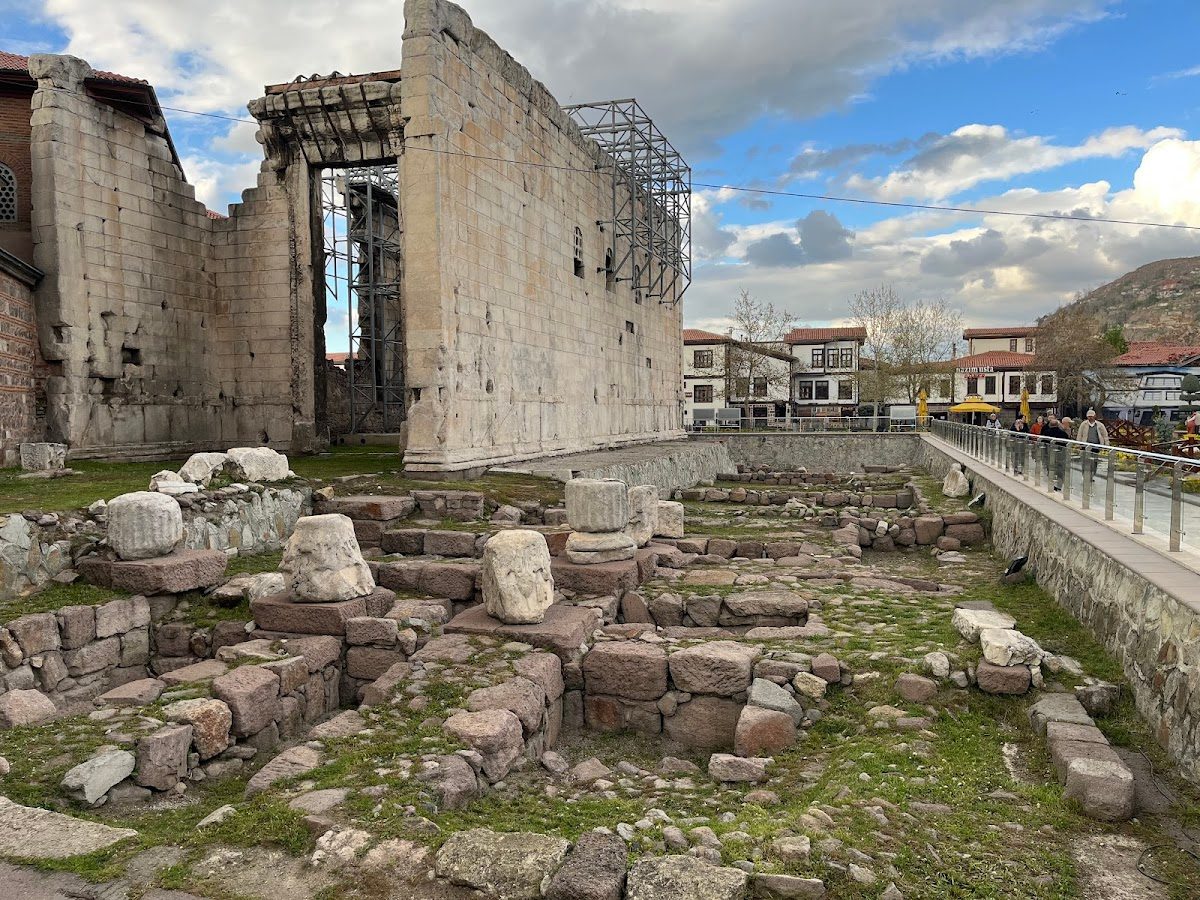
The Temple of Augustus, known by its monumental Latin name Monumentum Ancyranum, rises quietly today in Ankara’s Altındağ district, right next to the Hacı Bayram-ı Veli Mosque. Although it may look modest from the outside, the building is an unparalleled source for historians of the Roman world, because its walls preserve one of the most important political texts of antiquity: Emperor Augustus’ famous Res Gestae Divi Augusti. To understand the presence of the Roman Empire in Anatolia and how strategic Ankara—then called Ancyra—was, it is enough to walk up to the temple walls. The temple was built between the late first century BCE and the early first century CE in Ancyra, the capital of the Roman province of Galatia. It is thought that it was first dedicated to the Galatian god Men or to a pre-Roman cult center, and later rededicated to Emperor Augustus, turning it into an imperial temple. With its Corinthian columns, high podium and cella walls, it reflects the typical plan of a Roman temple. Although it lost its roof, its columned entrance and many architectural details over time, the standing walls and inscriptions keep it vividly alive in the eyes of scholars. The most striking feature of the temple is that it preserves the full Latin and Greek text of Augustus’ Res Gestae, in which he recounts his life, achievements, wars and the peace he brought to the frontiers of the empire. While the original bronze tablets in Rome disappeared, the most complete copy of the text survived in Ancyra, in this very temple. For this reason, the Temple of Augustus is often described as the building that houses “the most important Roman inscription in the world.” The lines running from left to right and top to bottom across the walls can still be made out by a careful eye, giving visitors the uncanny feeling of looking directly at a political autobiography written two thousand years ago. As Ankara went on to live through Byzantine, Seljuk and Ottoman periods, the temple took on new functions. In the early Christian era it was converted into a church, and with the construction of the nearby Hacı Bayram-ı Veli Mosque it became part of an Islamic urban fabric. Today, the temple ruins and the mosque courtyard stand side by side, forming a single scene that captures the multilayered history of Ankara in one frame. Climbing the stone steps, visitors hear the call to prayer on one side and the soft rustle of the wind brushing the inscriptions on the other, and they naturally reflect on how the city has changed over time. Today the temple area has the appearance of an open-air archaeological site. The walls are partially reinforced, and some sections are fenced off for protection, yet a significant part of the inscriptions is still visible to the naked eye. When taking photographs, the soft light of early morning or late afternoon is especially rewarding, as it brings out the shadows of the letters and reliefs on the stone surface. Walking through Altındağ’s narrow streets to reach the site allows visitors to experience both the everyday life of modern Ankara and the quiet of the ancient remains on the hill. The Temple of Augustus is no longer a fully preserved Roman monument with towering columns and intact façades. Yet thanks to the texts it carries and the multi-layered urban fabric that surrounds it, it remains an essential stop for history enthusiasts, archaeology lovers, and anyone who wants to get to know Ankara through the stories that lie beneath its surface.
Visit Tips
- Before visiting the Temple of Augustus, take a guidebook or app with you to learn about its historical and cultural context.
- Go early to explore the area around the temple; this way, you can avoid the crowds and take your photos more comfortably.
- During your visit, carefully examine the inscriptions inside the temple; these inscriptions provide important information about the Roman Empire.
- Don't forget to explore the Ulus district on foot after your visit to the temple, to easily access other historical sites in Ankara.