
 Powered by Google
Description
An important city of the Lycian League, an ancient settlement famous for its theater and colorful rock tombs.
Story
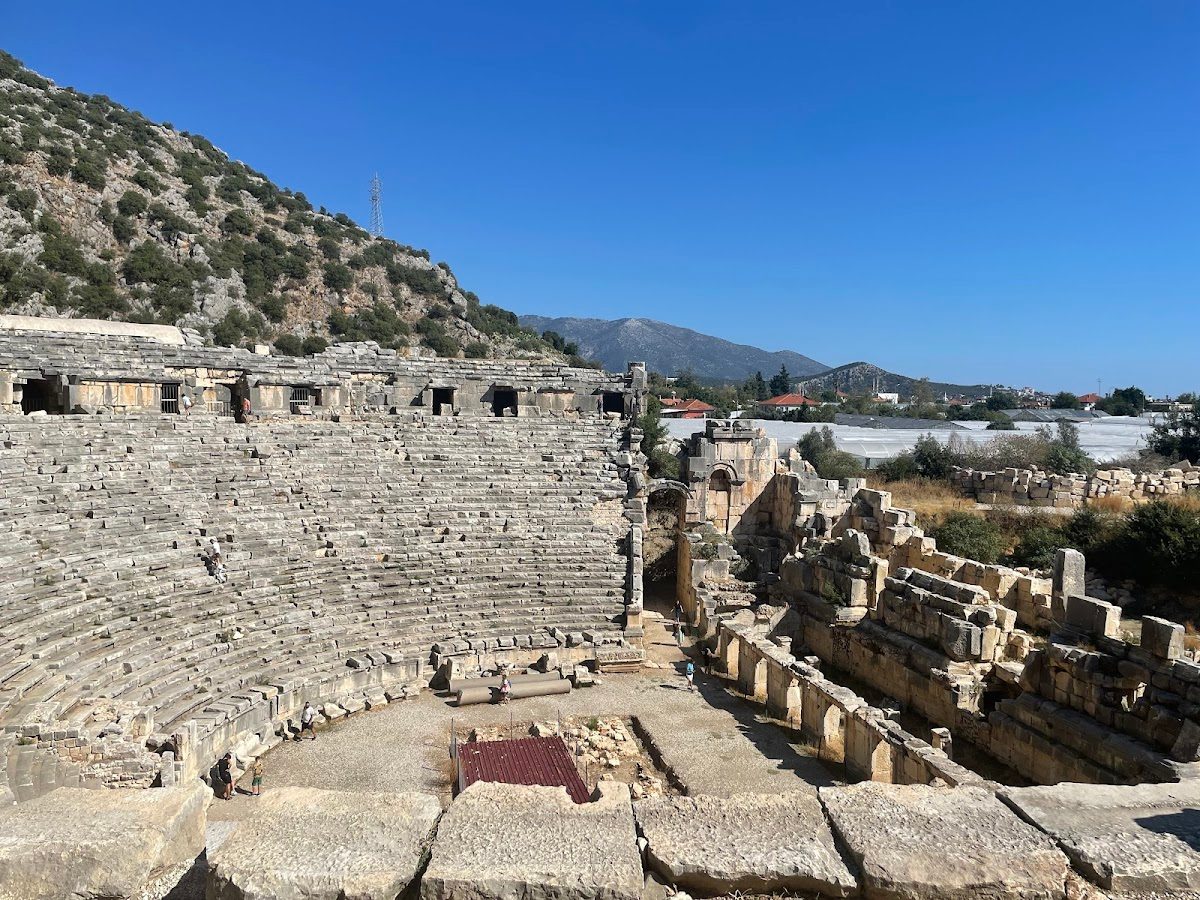
Myra, named after the ancient name of the Demre River, Myros, was a magnificent settlement considered one of the most important cities of the Lycian League. Today, the ruins of this ancient city rise on a flat area surrounded by citrus orchards, impressing visitors especially with its rock tombs and Roman theater. On the steep slope behind the theater, there are numerous facades of tombs carved into the rock; these tombs are famous for their decorations that replicate Lycian wooden house architecture in stone. It is known that in ancient times, these tombs were painted in vibrant colors, with shades of red, yellow, and blue stretching along the slope; although today only faint traces of these colors remain, the view is still quite impressive when combined with the imagination. Myra developed in the 5th-4th centuries BC and flourished during the Hellenistic and Roman periods; later, it gained significant importance in Christian history as the place where Saint Nicholas served as bishop. Its port, Andriake (present-day Çayağzı), opened Myra to Mediterranean trade, making it one of the economic centers of the region. Although earthquakes, floods, and the alluvium brought by the river have covered a significant part of the city over time, the theater and rock tombs have managed to survive to this day. When you climb the seating steps of the theater and look out over the plain, it is not hard to imagine that this area was once much closer to the sea, with ships docking at the port and goods being transported from the plain to the city. Myra is a stop that offers its visitors not only stone structures but also the rich spirit of Lycian civilization filled with symbols.
Visit Tips
- Tickets are purchased at the entrance of the Myra Ancient City; checking the validity of the Museum Card or e-Museum Card before going provides an advantage.
- The area is generally open around 08:30–17:30, but since the hours may vary depending on the season, it is useful to check for current information.
- Since there are few shaded areas, it is important to have a hat, sunscreen, and water, especially during the summer months.
- Although climbing to the rock tombs is limited today, reaching the upper tiers of the theater offers a sufficient height for the view.