
 Powered by Google
Description
Hierapolis is an ancient city that has survived from antiquity, famous for its thermal waters and travertines, and is listed as a UNESCO World Heritage Site.
Story
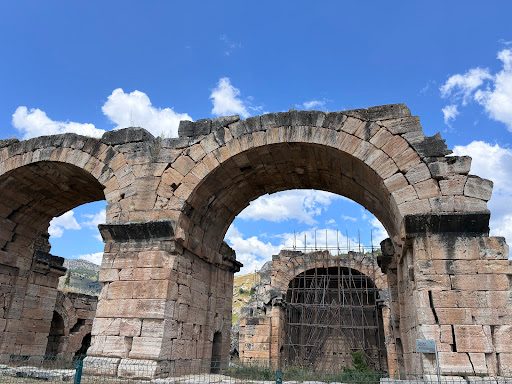
Hierapolis is an important ancient site located in the Pamukkale district of Denizli, which has survived from ancient times to the present day. The city's foundation dates back to the 2nd century BC and is believed to have been established during the Kingdom of Pergamon. It is rumored to have taken its name from Hiera, the wife of King Eumenes II of Pergamon. Hierapolis is particularly famous for its thermal waters and the travertine terraces formed by these waters. Since ancient times, it has been considered a center for health and healing, attracting many visitors with this feature. It experienced significant development during the Roman Empire, becoming an important center with its theater, agora, baths, and necropolis. It particularly enjoyed its golden age in the 2nd and 3rd centuries AD. The city also holds great importance in Christian history; it is believed that Saint Philip, one of the twelve apostles of Jesus, was martyred here, and his tomb is also located in Hierapolis. For this reason, it became an important pilgrimage center in the early Christian period. One of the most striking structures of Hierapolis is its ancient theater, which has a capacity of approximately 15,000 people and has survived to the present day in a remarkably well-preserved state. Additionally, it is home to one of the largest ancient cemeteries in Anatolia...
Visit Tips
- Visit together with the Pamukkale travertines, as Hierapolis is located directly above them.
- Wear comfortable shoes and carry plenty of water, as it spreads over a large area.
- Don't forget to use a hat and sunscreen, especially in summer.
- Be sure to see the ancient theater and the necropolis, as these are among the most impressive structures of the city.
- Discover its importance in Christian history by visiting the martyrdom site and tomb of Saint Philip.