
 Powered by Google
Description
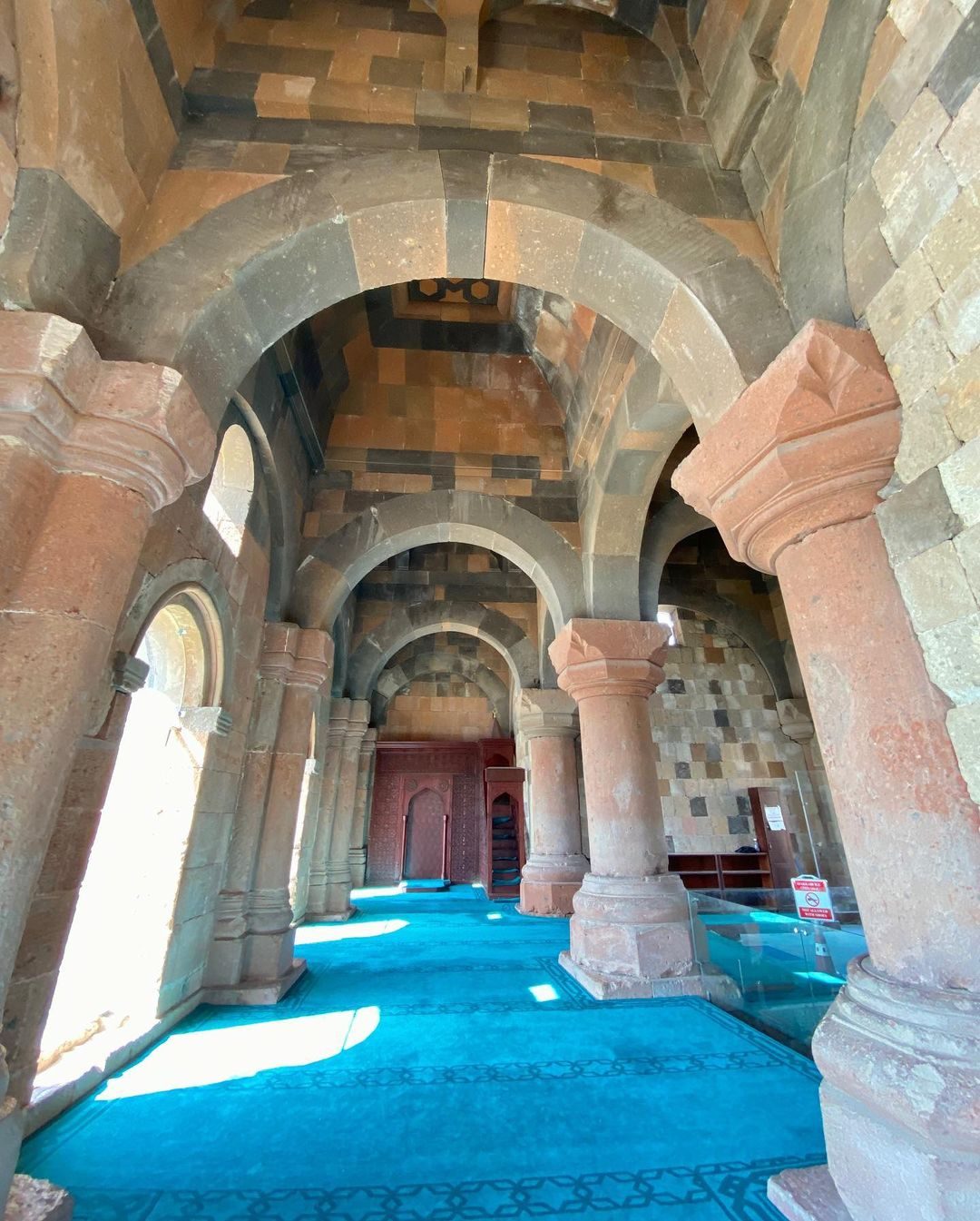
Ani Abu’l Manucehr Mosque is a historic place of worship rising on the edge of the cliffs of Ani Ruins and regarded as one of the oldest Seljuk mosques in Anatolia.
Story
As you leave Kars city center towards the Ani Plain, the first thing that appears on the horizon is the line of the city walls, followed by the sharp cut of the Arpaçay Valley. The building that dares to approach the edge of this cliff most boldly is the Ani Abu’l Manucehr Mosque. Dated to the late 11th century, the mosque was built by the Seljuk amir Abu’l Manucehr and is considered one of the first Seljuk mosques constructed in Anatolia. In this sense, it is not only a landmark of Ani, but also an early station of Anatolian Islamic architecture. The dark basalt stone and brick decorations used on the exterior create a solemn appearance that challenges Ani’s harsh climate. The almost square main hall was once covered with a wooden roof; today it is largely ruined, yet it is still possible to imagine the building’s original scale and proportions through the niches in the walls, the remains of arches, and the rhythm of the windows. The polygonal shaft of the minaret rises like a signal tower dominating the city despite the wounds opened by time; the traces of kufic inscriptions on it reflect the simple yet determined lines of Seljuk aesthetics. From the interior of the mosque, the windows opening onto the Arpaçay Valley create a natural stage stretching from the prayer hall towards the landscape. Silence is broken by the howl of the wind and the cawing of crows; this atmosphere forms a melancholy backdrop that recalls Ani’s past as a vibrant city of trade and culture. When you stand here and close your eyes, it is not hard to imagine the bells of caravans arriving from distant lands, the whispers of merchants walking in the courtyard, and the first calls to prayer echoing inside the mosque. Beyond its architectural value, Ani Abu’l Manucehr Mosque is a powerful symbol of the coexistence of Christian and Muslim heritage in Ani. Considered together with the nearby Armenian churches, it becomes a tangible witness to the cultural exchange between the Caucasus and Anatolia. For visitors today, this is not merely an impressive ruin for taking photographs, but also a kind of frontier station where religions, languages, and empires once touched each other. If you look carefully at the stones of the mosque, you can distinguish traces of repairs from different periods, showing that the building preserved its significance despite changing rulers over the centuries. As the sun descends over the Ani plateau, the light filtering through the mosque’s windows casts long shadows in the interior. At these hours, the silence of the ruins deepens, and one feels an invisible bond forming between oneself and history. When you leave the Ani Abu’l Manucehr Mosque behind, you carry away not only a handful of photographs, but also a lasting inner voice about the multi-layered history of Anatolia.
Visit Tips
- Adjust your visiting hours to sunrise or sunset; during these times, the beauty of the mosque and the surrounding scenery will be more impressive.
- Consider taking guided tours or using audio guide services to closely examine the interior architecture and stone craftsmanship of the mosque.
- When wandering around the Ani Ruins, wear comfortable shoes, as the area is uneven and requires walking.
- It’s a good idea to have enough water and snacks around the mosque, as there may be limited places nearby where you can buy food and drinks.